
Below is a review of the posts on Facebook and LinkedIn from the past week. You can check out the full posts by clicking on the links.
NOTE: after over 9 months there is still some instability and fluctuation in federal labor and employment law – and more expected with an EEOC quorum in place now – so check with us (or another employment lawyer) before taking action based on something in our posts.

The post on Sunday 10/26/2025 was about 6 labor and employment issues that are in flux. Know what is settled and what is not.
The beginning of President Donald Trump’s second presidency (a mere 9+ months out of a 4 year term) has already included “dramatic changes” in labor and employment policy and law — and more are expected. In that time, the administration has transformed more than six decades (yes, 60 years) of labor and employment policy with no indication the pace will slow. As key oversight and enforcement agency positions are filled (such as the EEOC that recently got a quorum again), further upheaval is anticipated.
Some of the changes benefit employers, but not all. Some of the changes at the federal level are being counteracted by so-called “blue states” passing laws that either give employees more workplace protections or try to tip the scale back in favor of workers. Here are some of the trends:
Federal “independent” agencies are in question. Days after taking office, Trump fired a number of officials at the EEOC and NLRB, among other independent agencies. Several of those officials have filed suits alleging that they were illegally terminated and challenging the president’s authority to remove federal agency leaders. See our posts of Sun. 2/23/2025, Mon. 2/24/2025, Fri. 2/28/2025, Wed. 3/5/2025, Sat. 3/8/2025, Tues. 3/11/2025, Thurs. 3/20/2025, and Mon. 4/7/2025 as well as the links in this post. The administration has questioned the constitutionality of Humphrey’s Executor v. United States (discussed in our posts of Mon. 4/7/2025, Fri. 4/11/2025, Sun. 4/13/2025, Sun. 4/20/2025, Tues. 4/22/2025 and Fri. 4/25/2025). And that battle may now be a foregone conclusion – see our post of Monday 10/27/2025.
Meanwhile, the firings left both agencies without a quorum (until the EEOC quorum was recently restored – see our post of Saturday 8/9/2025), limiting what they could do. Once quorums are in place, and depending on how the Supreme Court decides the constitutionality of the firings, the independence of those agencies might be in the rearview mirror. What could happen? See the post.
Union membership drops, but legislators consider worker-friendly laws. While unions hold more organizing efforts and elections, their membership continues to fall. Where union density was at the end of fiscal year 2024 is in the post. And at the same time, more states (see the post) have passed laws to ban or restrict employer-sponsored meetings, known as “captive audience” meetings. While the laws might seem friendly at first glance, there could be a big downside for employers – see the post. And there is movement at the federal level too with new legislation – see the post for more on that.
Administration pushes to eliminate diversity, equity and inclusion programs. Trump has targeted DEI programs and instructed agencies throughout the federal government to focus efforts on eliminating DEI programs as aggressively as possible. The crystal ball is murky as to what happens when those efforts are challenged in court, how aggressively the administration continues to press the issue, what various federal government agencies do to advance that agenda, and what states do in response. What employers with DEI initiatives should do in light of this uncertainty is noted in the post.
Changes to overtime and worker classification. Early in the year what the administration would do regarding the white-collar overtime threshold (which was raised by a Biden administration rule in 2024 and later vacated by a federal judge, which opinion is linked in the post). Then on Sept. 4 the U.S. Department of Labor confirmed that it intends to revisit the overtime regulations under the Fair Labor Standards Act. And there is litigation pending on appeal to the 5th U.S. Circuit Court of Appeals. See our posts of Friday 5/9/2025 and Friday 10/3/2025 for more on this.
The administration also might be acting relative to worker classification rules to allow more workers to be classified as [independent] contractors. For more on that, see our posts of Tuesday 9/16/2025 and Friday 9/19/2025. But on this front too states are responding as noted in the post.
Immigration enforcement is a priority. The Trump administration’s immigration-related policy changes and related enforcement actions mean employers should expect more I-9 audits and workplace raids. Yep, the next news cycle could contain something about your workplace! What do HR professionals and business owners need to do in this environment? See the post. And what industries are some of the hardest hit with the immigration enforcement? Yep, also in the post.
Artificial intelligence regulations are patchwork. The administration has emphasized “deregulation and technological competitiveness” relative to AI, which is a departure from the Biden administration. Again, states and localities are at the opposite end of the spectrum – see the post. But what that means for employers is they must keep a 360° view of applicable law and judicial decisions interpreting those laws. That includes internal compliance such as the things noted in the post.
TAKEAWAY: Employers cannot sit still, even for a day. Work with your HR team and employment lawyers to ensure you remain in compliance with each day’s legal requirements.

The post on Monday 10/27/2025 sadly reported Humphrey’s Executor executed in broad US Supreme Court showdown docket slaying.
In two-sentence order, without any accompanying reasoning, Chief Justice John Roberts ended almost a century of constitutional order. RIP Humphrey’s Executor!
Exercising tremendous restraint, Chief Justice Roberts managed not to write “Executor? I hardly knew her!” on the opinion functionally overruling Humphrey’s Executor. One might say that was the only restraint Roberts mustered since he used the infamous “shadow docket” to toss out 90 years of Supreme Court precedent to fit what those same people might deem “the dementia-fueled whims of his patron in the White House”.
As you know from our post yesterday, 10/26/2025, Trump wants to fire FTC commissioner Rebecca Slaughter, which the FTC’s authorizing legislation and Supreme Court precedent — aka Humphrey’s Executor — forbid. But he fired her anyway and she sued. What happened at the federal trial and appellate courts is noted in the post. And then came Roberts’ order.
In allowing Trump to fire Slaughter, Roberts did not say he “hardly knew her” when he devoted 2 sentences to ending nearly a century of precedent.
In his annual report (linked in the post), Roberts chastised judicial critics for failing to understand the Court’s opinions. So let’s look at the basis provided by Roberts for his bold decision. The Order itself embedded in the post. Yep, that’s it. Just an order, no opinion. So much for guidance for lower courts.
But wait – the last breath has not been drawn yet. This Supreme Court may want to overrule Humphrey’s Executor, but they have not done so yet. The shadow docket — where Roberts’ order was issued — is where the Supreme Court decides emergency requests while cases work their way through the legal process. Here the Trump administration said that it really wanted to fire one of the voting members of the FTC immediately rather than wait to see if the Supreme Court eventually overturns Humphrey’s Executor. The usual procedure for that type of case is in the post. But Roberts chose a different path based on four key factors detailed in the post (which are somewhat humorous and yet [sadly] seem somewhat true).
And while a shadow docket opinion like this normally would only apply to Slaughter’s case until it reaches the Supreme Court on the merits (or the case is sooner dismissed/withdrawn). But these are not normal times anymore and what may realistically happen is discussed in the post. So while Justice Gorsuch wrote (in the context noted in the post) that, “Lower court judges may sometimes disagree with this Court’s decisions, but they are never free to defy them,” it is hard for those lower courts to know why the Supreme Court ruled as it did so that it does not defy any such ruling if there is nothing but a short order.
In another life – ok, maybe a few weeks or month or so ago – multiple lower court judges told the media that the Supreme Court’s insistence on unexplained opinions overruling decisions that blocked Trump action has resulted in increased threats to their personal safety. And then Roberts did that exact thing again here.
TAKEAWAY: For now Slaughter’s firing from the FTC remains in place. And whether the administration will be further emboldened in similar situations remains to be seen (but can fairly be anticipated …).

The post on Tuesday 10/28/2025 noted harassment claim dooms UPS worker’s bias charge. A federal judge recently ruled that UPS did not illegally terminate a supervisor whom it found to have sexually harassed a female co-worker despite his claims that his firing constituted age and sex discrimination. Let’s look at some of the facts.
Johnson alleged UPS fired him within two months of his retirement plan vesting and replaced him with a younger female worker in violation of the Age Discrimination in Employment Act (ADEA), the Employee Retirement Income Security Act (ERISA) and state laws. But UPS claimed that the co-worker, whom Johnson accompanied during a training session, reported “an unsettling experience”. UPS investigated; its findings are in the post. The judge granted summary judgment to UPS, finding that Johnson had not carried his burden (i.e., did not rebut UPS’ evidence of a legitimate non-discriminatory reason for his termination).
While Johnson denied some of what UPS’ investigation found but confirmed others, he still claimed that he was unlawfully terminated due to his age and the proximity of his firing to his retirement plan vesting. But that did not hold water in light of what the judge found UPS had offered – see the post. In the end the court found that Johnson had not presented any direct evidence of age or sex discrimination. Good roadmap for employers.
TAKEAWAY: Employers should always have proper documentation and execution of internal investigations in case of future litigation. Talk to your employment lawyer about what should be in that file.

The post on Wednesday 10/29/2025 was about a condo crisis: calls for changes to help homebuyers.
How does your association fare with Freddie Mac and Fannie Mae eligibility requirements and its insurance deductible? The financials and logistics have changed for associations in recent years, both of which impact the attractiveness of a community to potential buyers. So with housing affordability challenges being a major storyline of 2025 in the industry, many potential homeowners have considered condominiums and townhomes as more affordable housing options. But condo markets in many states have been tough for brokers to find financing for customers. Many condos don’t meet federal agency guidelines, leaving non-QM and private financing among the limited options for these non-warrantable structures. And this is not just in Florida and California, it is hitting many states including many others on the Gulf Coast. Some things for buyers or finance professionals to look at are referenced in the post.
So what happens when a condo is non-warrantable? It means that the buyer must find funding options besides (mortgages guaranteed by) Fannie Mae and Freddie Mac. It’s not impossible, but it takes more work. See the post for (some of) the differences between warrantable and non-warrantable.
Another side effect of the current market is that while associations have insurance, there is a much higher deductible (to make the coverage affordable when passed on to owners through assessments). And the effect of that change? See the post.
And it’s not just what some picture as typical (high-rise) condos that are in this crisis. Townhomes also often comprise a condo association. Regardless of the type of housing unit, the underlying problems of warrantability and insurance coverage are there affecting possible future sales.
TAKEAWAY: Know what current Fannie and Freddie guideless are and if your community is in compliance as this be a big things to affect how easy it will be for owners to sell their units.
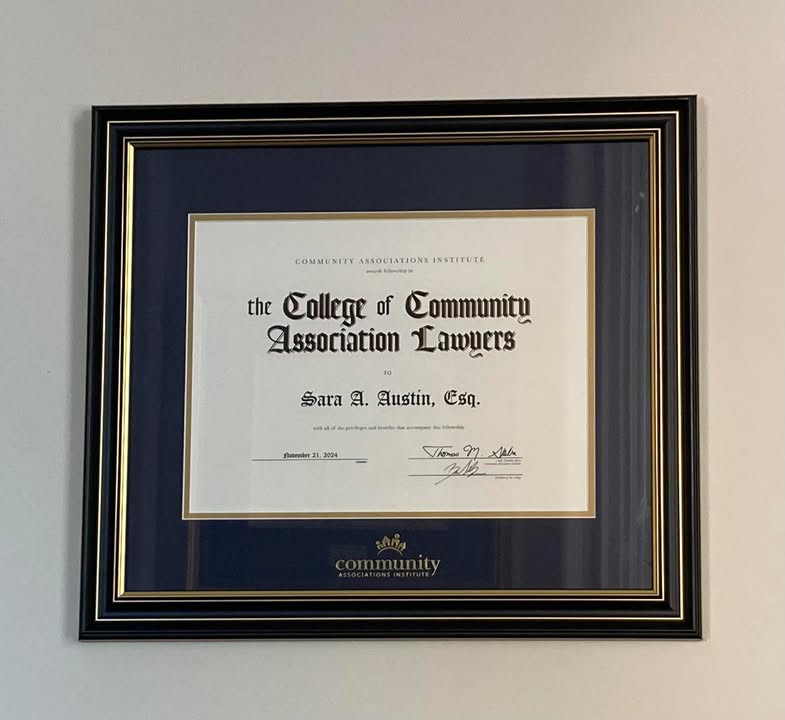
The bonus post on Wednesday 10/29/2025 congratulated Sara A. Austin, Esq. on her College of Community Association Lawyers (CCAL) fellow designation. She was accepted in November 2024 and formally inducted in February 2025, one of only about 175 such attorneys nationwide.
More than 4,000 lawyers practice community association law in the United States, yet only a small number can distinguish themselves as CCAL fellows. Attorney Austin earned this national recognition due to her outstanding leadership, commitment to the advancement of the legal principles and practical tools necessary for community associations to thrive. CCAL found that Austin possesses high ethics, strong analytical and writing skills, a substantial depth of experience and the ability to teach others in the field. Austin continues to be involved with the Community Associations Institute (CAI) in both the Keystone Chapter (having served as Chair of the Central PA Regional Council and periodically presenting educational sessions) and the national level (through participation on the national case law summary team for three years). Austin Law Firm continues to sponsor multiple CAI Keystone Chapter events in Central and Western Pennsylvania.
CCAL was established in 1993 by CAI, providing a forum for the exchange of information among experienced legal professionals working for the advancement of community association governance. Its goals include promoting high standards of professional and ethical responsibility, improving and advancing community association law and practice, and facilitating the development of educational materials and programming pertaining to legal issues.
TAKEAWAY: When you think of anything related to condominium or homeowner associations, think of Austin Law Firm and Sara Austin, Esq., CCAL.

In the post on Thursday 10/30/2025 we learned that condo handed win in scaffold scuffle. Even in the residential arena, you must know the legal ramification of any effect on owners. Let’s dive deeper here.
In a court decision handed down earlier this fall, a ground-floor commercial tenant in a condo building on Manhattan’s Upper East Side lost its request to compel the condo association to pay a monthly fee for the alleged damages and disruptions caused by a sidewalk shed erected in front of the tenant’s store. According to the facts in the case (listed and embedded in part in the post), commercial tenant Cameron Sky LLC (CSLLC) leased space on the sidewalk-facing ground floor of the New Yorker Condominium building at 1474 Third Avenue. When scaffolding and a sidewalk shed had to be erected to carry out work on the building’s façade required by a local law, the condo board apparently negotiated a license with the owner of the land underlying the building to allow the scaffolding, but it did not negotiate a separate license with CSLLC.
Not surprisingly, CSLLC objected to the scaffolding, claiming that it blocked their storefront’s visibility and deterred customers and asking the court to grant it a retroactive limited license if the structure was to stay up. CSLLC also requested that the condo pay CSLLC a licensing fee of $2,800 per month based on a state law (described in the post). That law is typically invoked when one owner must enter another owner’s space to finish necessary work.
Here the court considered whether CSLLC’s request met the legal standard as listed in the post. Ultimately, the court answered the questions and on September 8 denied CSLLC’s application, finding that the scaffold and shed on the public sidewalk in front of the store did not require a license under the state law. The court found that the intrusion by the scaffolding was limited to visibility and business disruption, and that even though CSLLC claimed business loss, that by itself was not sufficient to trigger the statute under the facts cited. The gist of the court’s analysis is described some in the post. Because CSLLC’s claim did not meet the legal standard, the condo board’s motion to dismiss CSLLC’s petition was granted.
If you’ve gotten this far, you may be wondering why you care. The decision reinforces how important it is for association boards (whether condominium or homeowners) to be informed about the statutory implications of major capital projects and to engage competent legal professionals to help navigate the process. As to exterior work might affect adjacent units or tenants (in the residential but especially the commercial arena), things to be considered ahead of time are listed in the post. Yes, advance planning extends to more than just finances.
The case highlights the importance of careful, conscientious planning when it comes to big exterior projects. To limit potential liability and disputes, boards and their legal and engineering advisors should anticipate the impact of facade projects on neighbors and residents alike, and work to ensure clear communication and secure appropriate licensing before the first piece of scaffolding goes up.
TAKEAWAY: When it comes to big projects, associations should plan for any anticipated impact on owners (and tenants) and ensure compliance with all applicable laws and ordnances. A community association lawyer can assist.

The posts on Friday 10/31/2025, here and here, were about decorating blunders that could spook your HOA or condo this Halloween season. Know what you can or cannot do before a violation occurs.
Halloween decorations add fun and flair, but if you live in an HOA or condo community, rules or other restrictions can crash the party and dim your spooky spirit. You care because some goals of community (condo and homeowners’) associations are to keep the neighborhoods safe, tidy, and welcoming. So over-the-top decorations could spark complaints, disputes, or even scary-high fines. To avoid that, let’s look at a few common Halloween headaches in community associations and how to control them.
Keep noise in check – Motion-activated screams, haunted house soundtracks, or loud effects may violate noise limits (of the association or even the local municipality). When you think the kids are wrapping up trick-or-treating, turn those noises down or off.
Mind the lights and timing – This is similar to noise, but can also have health effects for some people. Bright displays can disturb neighbors. So take some or all of the steps noted in the post.
Watch the yard art. They are everywhere! But inflatables, gore, or weapon-like props may not comply with your association’s restrictions. And they may impede the ability to see, especially for those in costumes. Some suggestions for safety and potential association compliance – while still keeping the scary fun – are in the post.
Be mindful of timeframes. This is huge. Most associations have limits on when you can put up and by when you must take down decorations. Know what those limits are and make sure you comply – or you might end up paying a lot more for those wilting pumpkins and dangling spiderwebs on your doorstep than you intended.
Respect religious sensitivities. Some associations restrict decorations with religious ties. Again, know what your association does or does not allow BEFORE putting up your decorations.
Sometimes it’s a hard no. You know that your association can decide that your holiday décor is a violation of its restrictions. Your choices at that point usually are limited to those listed in the post. So again, know what your association does or does not allow BEFORE putting up your decorations’
TAKEAWAY: Celebrate Halloween with creativity but know your condo or homeowners’ association restrictions and rules AHEAD OF TIME to avoid a frightful conflict or worse.

Finally, in the post yesterday 11/01/2025, we read that EEOC alleges bottling company fired employee because of her MS despite doctor clearance. Ugh.
The EEOC alleged in a suit filed in early September that Piedmont Cheerwine Bottling Co. allegedly violated the Americans with Disabilities Act (ADA) when it required an employee with multiple sclerosis (MS) to submit to a medical exam and fired her after receiving the results. The complaint is linked in the post, but let’s look at the facts generally.
The employee was a store merchandiser at Cheerwine Bottling’s soft drink manufacturing and distribution facility. She walked with a limp due to MS medication that had caused deterioration in her hip cartilage. Six weeks into the job, she was required to take a physical agility test, the only new hire to undergo the test before the end of a 90-day probationary period. Test results indicated she met all four job-specific requirements but noted that she had decreased strength in her hip, gait abnormalities and difficulty squatting. After the test, Cheerwine placed the employee on unpaid leave and fired her the same day. The next day, she provided a doctor’s note clearing her for work, but Cheerwine rejected the note and told her she’d already been terminated. (No “let’s raise the glass” there.)
So the EEOC sued Cheerwine, alleging that it fired her because of her disability or because it regarded her as disabled (don’t forget about that part of the law!) in violation of the ADA. The EEOC also alleged that the physical agility test was an impermissible medical exam under the ADA.
EEOC guidance on when an employer can require a current employee to submit to a medical exam is linked in the post. The guidance also discusses physical agility tests in the context of medical exams (i.e., when they come within those parameters).
In the Cheerwine suit, the EEOC pointed to several factors it said indicate that the physical agility test was a guise for requiring the employee to undergo an impermissible medical exam. Those things are listed in the post. And, to top it off, the employee was also unlawfully asked about her hip, causing her to reveal disability-related information about her MS medication and resulting limp.
Employers can show that a medical exam was job-related and consistent with business necessity — and therefore justified under the ADA and EEOC guidance — by providing reasonable, objective evidence that a medical condition prevented the employee from performing essential functions. But here Cheerwine did not meet that burden as noted in the post (according to the EEOC’s allegations).
Cheerwine’s response to a request for comment is also in the post.
TAKEAWAY: Employers must understand all parts of the ADA that apply to their workforce, from who is eligible for ADA protection to what they as employer must do and what they must not do. Get an employment lawyer involved early on to ensure legal compliance.