
Below is a review of the posts on Facebook and LinkedIn from the past week. You can check out the full posts by clicking on the links.
NOTE: after over 9 months there is still some instability and fluctuation in federal labor and employment law – and more expected with agencies gaining quorums – so check with us (or another employment lawyer) before taking action based on something in our posts.

The post on Sunday 11/2/2025 told us Kroger faces FMLA, PUMP Act lawsuit after allegedly transferring employee returning from parental leave. Let’s see what happened.
A Kroger HR department is at the center of a suit filed recently in federal court in Indiana that alleges violations of the PUMP Act and Pregnant Worker Fairness Act (PWFA), among other things.
A former assistant store manager alleged that she was denied use of available time off before her upcoming leave for childbirth — despite similarly situated male employees being allowed to take time off. She also allegedly faced unsavory pumping conditions and negative comments about her pumping. The plaintiff said that after she complained to the district HR, she was transferred to a different store, 37 miles away in an allegedly dangerous area.
The plaintiff alleged that these actions were retaliation for exercising her FMLA rights (as described in the post). She also alleged that Kroger management violated the PWFA (again, a description is in the post). Finally, the plaintiff alleged violations of the PUMP Act (yep, description is in the post).
A lack of proper accommodations for pumping have been the crux of several lawsuits since the PUMP Act took effect. There have been suits alleging that employees were forced to express breastmilk in hot cars and unlocked storerooms (a link to which is in the post) or in mail trucks and break rooms where co-workers were present (a link to the latter is also in the post).
The Kroger employee here alleged that she was only permitted to pump in bathroom stalls, a security room with cameras, a glass office and a closet without any lights. Also, when she returned to work, an assistant manager told her that storing her breast milk in the refrigerator was “disgusting.”
A few (simple and inexpensive) best practices for nursing workers are listed in the post.
TAKEAWAY: Employers have an obligation to accommodate pregnant and nursing women – talk to an employment lawyer to ensure you know and meet your obligations.

The post on Monday 11/3/2025 noted court revives White former school executive’s bias case over allegedly racist DEI training. Roadmap for employers.
The federal 2nd Circuit Court of Appeals recently held that New York City’s Department of Education may have subjected a White former educator to a hostile work environment when it required her to attend mandatory implicit bias training in which co-workers made comments that a rational jury could find to be racist. Let’s look at the facts here.
Chislett alleged race discrimination manifested in the form of a demotion, hostile work environment and constructive discharge. The trial (federal district) court granted summary judgment to the City on all three counts, but the 2nd Circuit overturned with respect to the hostile work environment claim.
In the analysis that accompanied its decision, the 2nd Circuit called out training instructors who repeatedly said that “values of [w]hite culture are supremacist” as well as similar comments and other behaviors as noted in the post. The court said that the comments were made outside of training and that a jury could possibly conclude that a consistent pattern of harassment took place. That is NOT a decision an employer wants to hear.
This decision comes amid a broader backlash against DEI programs as federal courts have more and more often been asked to weigh in on the legality of DEI training on subjects such as implicit bias. That litigation is itself part of a growing trend of so-called “reverse discrimination” suits brought by majority-group plaintiffs.
Here, the 2nd Circuit held that while implicit bias training may not be discriminatory per se, the alleged conduct included negative generalizations and stereotypes of White people. Conversations outside of the training also played a part – see the post. And Chislett claimed that she was called a racist and labeled “white and fragile” after disciplining or managing subordinates. The Court said that, “What matters here is the way the trainings were conducted,” the 2nd Circuit said. “Its rationale for that is in the post.
The court also faulted Chislett’s supervisors for not intervening when she complained about the alleged conduct. One instance in particular was singled out by the court and is in the post.
Employers are already looking more closely at any surviving DEI training amid backlash from regulators. Training that makes a specific race or gender feel impugned, less than or guilty may violate employment laws like Title VII. And don’t forget that the U.S. Department of Justice issued a memo in July (which is linked in the post for easy access) about what kind of DEI training is unlawful.
Circling back to this case, Chislett is one of several White employees of New York City’s Department of Education to sue for alleged discrimination that occurred during the tenure of former Chancellor Richard Carranza. After one of the other suits, in 2019 city lawmakers wrote a letter (linked in the post) to then-Mayor Bill de Blasio criticizing Carranza. Carranza resigned from that position in 2021.
And Chislett is not alone. Other plaintiffs have filed suits challenging their employers’ DEI training or messaging. This past March a Pennsylvania federal judge dismissed one White former professor’s suit (linked in the post) claiming that his employer’s communications and invitations to participate in conversations around antiracism created a hostile work environment. That case remains on appeal to the 3rd Circuit.
Another example is detailed in the post.
TAKEAWAY: Employers are under a microscope – any little thing will loom large and might catch the eye of the DOJ – to say nothing of a judge or jury. Base decision on current legal interpretations.

The post on Tuesday 11/4/2025 told us Judge orders HOA to take care of historic Black cemetery. Yep, the declaration / CC&Rs rule.
The judge ordered a townhouse homeowner’s association to take care of a historic Black cemetery on its property. Let’s take a closer look at how this came about.
Piney Grove Cemetery has more than 300 graves, some of which predate the Civil War. Last year, it was named on the Georgia Trust for Historic Preservation’s Places in Peril list (which is linked in the post). Resting behind The Bluffs at Lenox, the cemetery is overgrown and hard to access. In 2024, an advocacy group, along with two descendants of people buried there, filed suit against the HOA, demanding that it maintain the graves. Some of what is on the advocacy group’s website is in the post.
In the recent order, the Judge noted that the townhome community’s own Declaration of Covenants includes an obligation to maintain the cemetery. The Judge’s Order is embedded in the post.
The Judge also ordered the parties to submit by early November a joint injunction outlining a maintenance plan (and noted that if they cannot reach an agreement, the case will proceed to trial).
How the Judge (poetically) described the land at issue is in the post.
NOTE: there is also a VID embedded with the post.
TAKEAWAY: Community associations often enforce the Declaration/Covenants against an owner; here, however, the enforcement is against the association itself (because it too is bound by the document).

The post on Wednesday 11/5/2025 was about EEOC realigned: Panuccio confirmation ushers in new era. Priorities of DEI eradication and religious freedom get large boost.
The pendulum swung sideways a bit more about a month ago. On October 7, 2025, the U.S. Senate confirmed Brittany Bull Panuccio by a 51–47 vote to serve as an EEOC commissioner for a term expiring in 2029. That confirmation provides Republicans with a majority on the Commission and positions the agency to officially (as opposed to just Chair Lucas’s statements) realign its enforcement and policy priorities with the President’s America First agenda.
The new EEOC is expected to officially shift focus by scrutinizing DEI initiatives, religious liberty, and discrimination, and more as noted in the post (including what actions will decrease as others are ramped up). Employers may want to prepare for increased EEOC attention to claims of majority and religious discrimination, review their DEI and accommodation policies, and monitor for changes in federal guidance and enforcement.
Commissioner Panuccio’s background is described in the post. With her confirmation, the EEOC’s current composition includes (Acting) Chair Andrea Lucas (whose term length is noted in the post), and Commissioner Kalpana Kotagal, the sole remaining Democrat After the President’s January 2025 dismissal of former chair Charlotte Burrows and former vice chair Jocelyn Samuels. Samuels has filed suit over her removal (see our post of Sun. 4/20/2025) and one Commission seat remains vacant. The January 2025 removals had left the EEOC without a quorum, meaning that it could not engage in rulemaking and certain litigation until confirmations restored the quorum.
The Commission is expected to prioritize investigations (or inquisitions) of DEI practices alleged to result in unlawful race- or sex-based decision-making, with the emphasis as noted in the post. Disparate impact enforcement is expected to decrease sharply, redirecting those resources toward intentional discrimination theories and job-related justifications. In the sexual orientation arena, changes are also expected as described in the post, especially in light of some of the Supreme Court’s recent decisions in that area.
And the EEOC may also devote greater attention to perceived majority discrimination, including those noted in the post, and recalibrate the PWFA rule and interpretations related to abortion-related leave. Other expected changes in enforcement are described in the post. And of course only time will tell if the EEOC will revise its current strategic enforcement plan.
As this post was written, the federal government remains shut down, so there are only four staff members remaining to support the work of the Commissioners. What (fitting?) effect that might have is noted in the post.
So what should employers do as the EEOC prepares to act on its (changed) enforcement priorities? The list includes reevaluating DEI programming (for the purpose noted in the post), reviewing policies that address gender identity, facilities access, and pronouns that comport with current federal, state and local law; and several others listed and described in the post. There will continue to be an increased emphasis on claims alleging religious discrimination, majority discrimination or national origin discrimination so employers should get their houses in order (as noted in the post) to deal with that.
TAKEAWAY: The EEOC quorum may spur some employers to act; that action should be accompanied by contact with an employment lawyer so as not to step on any legal land mines.

In the post on Thursday 11/6/2025 we learned Court approves $43M settlement in Disney gender pay discrimination case. Yep, Mouse moolah. Let’s look at the background.
A state judge recently granted final approval of a $43.25 million settlement in a class-action lawsuit alleging that The Walt Disney Co. underpaid women workers, according to court documents. And the underpayments were not small – see the link in the post. The lawsuit also alleged that Disney skipped over women for promotions and assigned them extra work without pay. Disney replied to the charges both by court filing (which is linked in the post) and comment (yep, see the post).
The settlement did not include only the mega-millions, but also other non-monetary things. See the post for specifics and timing.
This is not a newly-filed suit; it was filed almost 6 years ago and alleged violations of state wage laws. The Judge granted preliminary approval of the settlement on May 20 and final approval more recently during a hearing.
What the plaintiffs’ lawyers said about the nonmonetary terms of settlement “is in the post.
The settlement comes at a time where there is increased awareness and legislation regarding pay equity and pay transparency. But that doesn’t mean that companies’ compensation processes are ready for the heightened scrutiny. What employers did say in that regard is detailed in the post.
TAKEAWAY: A lot of money will change hands for something that should never have happened – do yourself a favor and stay on the right side of legal from the start (i.e., no discrimination).

The post on Friday 11/7/2025 was about veteran locked in lawsuit with HOA over driveway built without permission – but what about Fair Housing Act?
A look at the background is necessary to understand why the HOA did (or did not do) what it did (not do).
Jimmy Moore, Florida resident and Army veteran of 23 years, and his wife Miranda are being sued by their HOA for what it calls an impermissible alteration to their property. Eleven years ago they began looking into building an emergency second driveway for their home to gain additional space for Jimmy, a multiple sclerosis patient who uses a wheelchair, to safely enter and exit his specially-equipped van. How the van helps and why Jimmy needs the space is in the post. NOTE: in several places throughout the post there are a photos of the van in his driveway to give you some background.
The HOA denied Jimmy’s initial request, prompting he and his wife to once again speak with the HOA’s Architectural Review Committee. Jimmy even provided medical documentation (linked in the post), to little avail. How Jimmy said the HOA responded to that is also in the post.
So Jimmy and his wife decided to go ahead with the driveway install anyway given how important it is to Jimmy, but that is why the HOA is now suing them. The suit alleges they violated HOA rules by not submitting an application to construct the driveway (which of course means it was never approved) and the effect of the construction (as noted in the post). The HOA is demanding that they restore the lot to its originally approved composition and appearance prior to the alterations.
But Jimmy and his wife are fighting back. Their argument, and what they want, is in the post. The Moores have spent about $30,000 in attorney fees so far to fight the suit. They look around the community and explain why their situation is unfair and distinguishable – see the post.
As must associations in all states, here the HOA must abide by the federal Fair Housing Act (the requirements of which are linked in the post). That makes a difference in Jimmy’s situation.
TAKEAWAY: regardless of whether a requested alteration conforms to an association’s Governing Documents, the association has a legal obligation under the FHA to accommodate owners’ disability. Consult a community association lawyer.
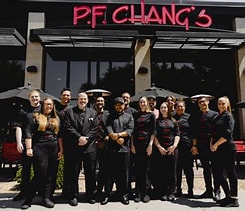
Finally, in the post yesterday 11/8/2025, we read that P.F. Chang’s settles claim it refused to hire applicant who asked for Sundays off.
P.F. Chang’s has agreed to pay $80,000 to settle an EEOC charge alleging that one of its restaurants refused to hire an applicant who requested Sundays off due to his religious beliefs (see, one of the EEOC’s enforcement priorities we told you to anticipate in our post of Wed. 11/5/2025).
The EEOC said that its investigation showed that the employee’s request constituted a religious accommodation request and that P.F. Chang’s did not hire him because of that request, thus violating Title VII. The parties engaged in typical pre-litigation conciliation but this time it resulted in a resolution.
P.F. Chang’s agreed to provide back pay and compensatory and punitive damages as well as provide the non-monetary relief detailed in the post.
So what can employers learn from this? First and foremost, schedule changes are a common example of religious accommodation under Title VII, according to an EEOC fact sheet. The EEOC’s comment about the settlement, as well as a suggestion for employers, is in the post.
This is not the only case filed by the EEOC alleging religious bias (or failure to accommodate). One such case was filed in 2024. Details about that case (and a link to it) are in the post.
Much of this comes as employers are still grappling with the U.S. Supreme Court’s 2023 decision in Groff v. DeJoy that changed the standard by which undue hardship is evaluated with respect to religious accommodation under Title VII. See in the post how the Groff case is especially relevant here.
More on Groff is also in the post, including what employers make consider when evaluating a religious accommodation request.
Post-Groff suits challenging employers’ undue hardship defenses have had mixed results. Recently the 9th U.S. Circuit Court of Appeals held that a fire department did not discriminate against a group of employees who requested a vaccine exemption because of religious beliefs. See our post of Sun. 9/28/2025 for more on that.
The EEOC has repeatedly taken the stance that schedule changes may be reasonable under Title VII. In July it filed suit over failure to accommodate requests to accommodate religious beliefs via schedule change – the case, which remains pending, is linked in the post.
Then in August the EEOC’s Office of Federal Operations issued a decision finding that the U.S. Department of Veterans Affairs failed to accommodate a Muslim employee’s request to attend weekly prayer service. That too is linked in the post.
TAKEAWAY: As the current administration emphasizes religious freedom in the workplace, employers must adapt and know what their obligations are relative to accommodation requests. An employment lawyer can help.