
Below is a review of the posts on Facebook and LinkedIn from the past week. You can check out the full posts by clicking on the links.
NOTE: there is still a bit of instability and fluctuation in federal labor and employment law – with more to come – so check with us or another employment lawyer before taking action based on something in our posts.

The post on Sunday 10/05/2025 was about how to write an AI ethics policy for the workplace (and yes you need one).
If there is one common thread throughout recent research about AI in the workplace, it’s that there is no definitive take on how people are using the technology and how they feel about the imperative to do so. But still, there’s a lack of clarity around which tools should be used (including those mentioned in the post) and when, because of the broad range of applications on the market. While businesses have implemented those tools, policies on their usage are often confusing to employees, leading to unsanctioned (but not always malicious) use of certain of the tech tools. And that can result in unethical or even allegedly illegal use, including data privacy concerns, running afoul of state and local laws, and giving rise to claims of identity-based discrimination (which is defined in the post).
Compliance and culture go hand in hand – While AI ethics policies largely address compliance, culture can be an equally important component. How employees are affected when employers explain the reasoning behind AI rules is in the post. That, in turn, creates an environment where employees not only use AI compliantly but also responsibly.
The best AI policies answer two questions: How will AI help teams do their best work, and the other one in the post. These questions put employees first, not the technology.
Consider industry-specific issue – Industries involved in creating AI tools have additional layers to consider: research shows that software vulnerabilities were the top cause of data breaches in the U.S. last year. There are potential issues that can be baked into AI depending on how it is trained – see the post for more on that. So an AI disclosure policy should address security risks, create internal review guidelines for AI-generated code, and provide training to promote secure coding practices. And for those involved in content creation, more policy content is discussed in the post. The policies tell the public (the users) that human input has been involved and, in addition, it establishes responsibilities for employees to comply with necessary disclosures.
Other things that should be considered are also in the post, including how AI is used in the company’s products or services.
The policy’s in place. What now? – AI technology is constantly evolving, so employers must remain flexible. How to look at and treat the policy is explained in the post. And periodically test the AI policies and update them so they stay relevant, effective and legally compliant
TAKEAWAY: It is not a question of whether to have an AI policy, but whether your policy has the necessary content now and in the future. Talk to your employment lawyer.

The post on Monday 10/06/2025 told us auto dealership will pay $275K to settle claims it segregated roles by sex.
Landmark Dodge and Landmark South, an automotive dealership has agreed to pay that amount to six women denied sales jobs, eight men denied office jobs, and two HR employees per the EEOC’s late August announcement.
The complaint (linked in the post) alleged that Landmark Dodge’s owner told two new HR professionals that women aren’t cut out to be good salespeople and men don’t do well in office roles. What the HR pros found that hiring managers were doing is noted in the post.
But the monetary relief is not all. The dealership entered into a five-year consent decree which requires the non-monetary relief described in the post.
The EEOC has previously pursued cases where HR professionals face retaliation for not upholding discriminatory practices. For example, last summer, a Pennsylvania-based construction company paid $50,000 to settle allegations that it retaliated against an HR person who investigated sexual harassment complaints against their company’s general manager. That case is linked in the post.
And in 2022, the 11th US Circuit Court of Appeals held that Title VII can protect HR professionals from retaliation when it comes to giving depositions against a former employer. That case is identified in the post in addition to the allegations it dealt with.
A statement from the EEOC’s regional attorney is near the end of the post.
TAKEAWAY: Don’t discriminate or retaliate against employees – and especially not those you have hired to legally deal with employee issues.

The post on Tuesday 10/07/2025 was HOA Q&A: Can a person be delinquent in paying assessments and still be on the board (for election and through term)? Let’s look at a scenario.
The ballot for a condominium election includes someone who is habitually in arrears in the payment of assessments. The candidate is current now, but the question is whether there is any law relative to being delinquent and being eligible for the Board.
The answer is “it depends”.On what the association’s governing documents provide as well as any provisions of applicable law.
In Florida, one statute provides that “a unit owner in a residential condominium desiring to be a candidate for board membership must be eligible to be a candidate to serve on the board of directors at the time of the deadline for submitting a notice of intent to run, to have his or her name listed as a proper candidate on the ballot or to serve on the board.” Another statutory section talks about the effect, if any of delinquency of eligibility for election to the board – see the post.
TAKEAWAY: PA statutes on condominium and homeowner associations and cooperatives are very similar and include provisions related to the content of the declaration and bylaws relative to board eligibility. Consult a community association lawyer.
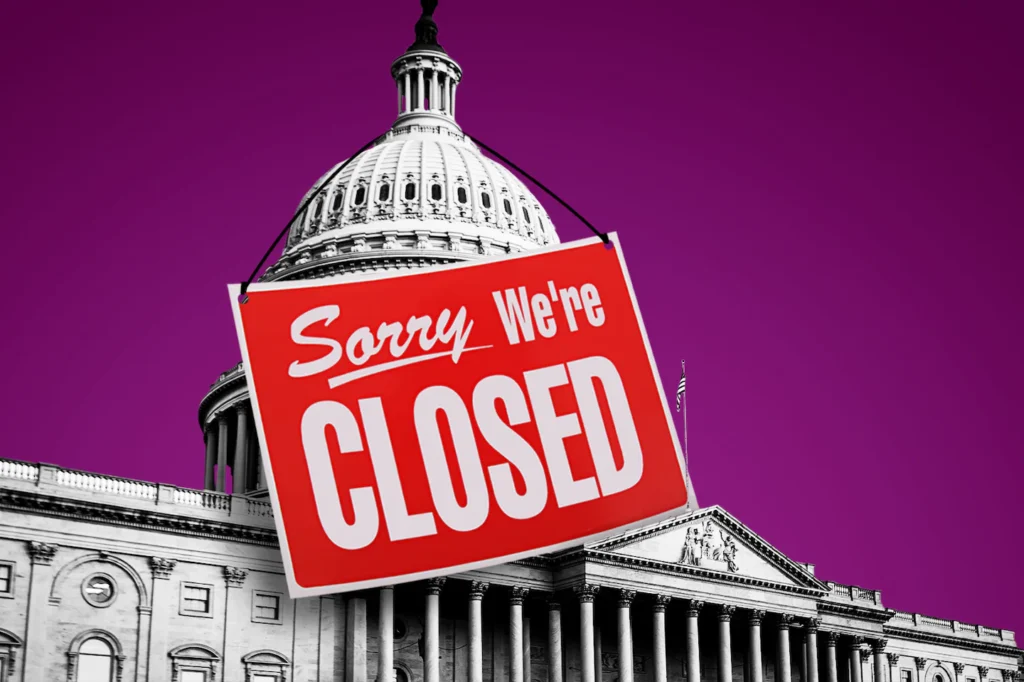
The post on Wednesday 10/08/2025 talked about how the government shutdown will affect HR. The domino effect. (image by Washington Post)
The shutdown started October 1st – so the post was a week in and it’s now a few days past that. Employers should expect – and have probably been experiencing – suspension of key functions at agencies like the EEOC and the DOL until Congress comes to an agreement. Especially now that (as of Oct. 10) there is a threat to turn many furloughs into actual layoffs ….
HR professionals who have worked in the industry through the last several presidential administrations may be familiar with disruptions caused by shutdowns (past ones of which are linked in the post). The most recent shutdown began in December 2018 during President Trump’s first term. It lasted five weeks; what the Congressional Budget Office says was the lost gross domestic product during that shutdown is in the post (and it’s a very large number!).
Let’s take a closer look at the relevant employment-related federal agency activities to be interrupted by the current shutdown (and comments on anticipated broader effects).
Several immigration procedures paused — including E-Verify – The US Citizenship and Immigration Services is a fee-funded agency, meaning employers should not see disruptions to filings for non-immigrant or immigrant visas (which may or may not soon start carrying a substantially increased fee if Trump has his way). But the US Department of Labor has said it not process foreign labor certification applications during the shutdown; the effect of that is in the post.
Additionally, the Department of Homeland Security’s E-Verify program is expected to be (and was) completely unavailable. The effect that has had on employers is in the post. NOTE that if news sources are to be believed, E-Verify is or will soon be running again. That means employers can process Form I-9s for new workers that have been waiting for the system to open again.
Unlike DOL, DHS has said that several other functions will continue during the shutdown, including law enforcement operations and certain port-of-entry functions. And what about most US Immigration and Customs Enforcement personnel? See the post.
EEOC disruptions affect litigation, charge processing – The EEOC’s contingency plan when funds lapse provides that staff will not be available to answer questions from the public or respond to associated correspondence. What will they do? Activities involving the safety of human life or the protection of property and those activities required by statute (to be determined as noted in the post). The EEOC will also accept charges and internal federal sector – but there will be no investigations during the shutdown. The EEOC will also cancel mediations and pause federal litigation under the circumstances noted in the post.
The lack of EEOC investigations of charges filed during the shutdown is expected to create a months-long backlog. NOTE: a new Commissioner was confirmed this past week, such that a quorum now exists. But it is doubtful that the EEOC will (or can) act now amidst the shutdown …
A scant situation at DOL’s Wage and Hour Division – The US Department of Labor said in its contingency plan that only 10 (not a typo) of the 1,270 full-time employees in its Wage and Hour Division will work during the shutdown. Ten. Regulatory work has stopped, while enforcement activities are limited only to those involving emergencies related to the safety of human life or protection of property (similar to the EEOC). And what about ongoing litigation? See the post.
NLRB’s quorumless conundrum adds wrinkles – The National Labor Relations Board lacked a quorum for several months prior to the shutdown. And now it is expected that the lapse in federal funding means much of the agency’s day-to-day work is also likely to grind to halt. That includes handling of cases before the Board and more as detailed in the post. During past shutdowns the NLRB granted automatic extensions to parties required to file documents with the agency in ongoing cases and it is expected to do so again during this shutdown.
And because of its lack of a quorum, the NLRB is expected to accumulate a backlog of union petitions during the shutdown. What that means for employers is in the post.
HR departments face ‘avoidable disruption’ – It is expected that the Trump administration will further reduce staffing in federal agencies, affecting employees and contractors. Some unions representing federal workers filed suit – what they seek is noted in the post.
But the federal workforce is not the only place that will be affected. Even a brief shutdown (and we are past “brief” already) disrupts daily operations for an estimated 25% of organizations and puts almost that many annual financial goals at risk. The longer the shutdown persists, the larger the share of affected employers.
Some of the things HR departments will need to do include managing furloughs, processing payroll changes, and addressing employee anxiety, all under tight timelines.
TAKEAWAY: The shutdown has a continuing domino effect on employers and workers – you probably know one or more people or businesses already touched by the shutdown.

In the post on Thursday 10/09/2025 we saw that US Dept. of Labor brings back staff who took ‘fork’ offer.
Remember DOGE and its “fork in the road” email? Well now workers who opted into the administration’s deferred resignation program (described in the post) – voluntarily taking paid administrative leave with the expectation of leaving their jobs – are returning to DOL. That should help clear up some backlogs …
A few current DOL employees, speaking on condition of anonymity, said that colleagues who took DOGE’s “Fork in the Road” offer earlier this year have returned as full-time workers after having received full pay and benefits for months without having performed their job duties. And what does a portion of the agency’s internal website say? See the post.
The reinstatements demonstrate the whiplash federal workers face when the President’s directives to shrink the government collide with the demands of an agency’s day-to-day work. Is anyone surprised that reality intrudes? And DOL is not the only agency in this position – see the post.
Apparently DOL is considering rescinding deferred resignations for 100 positions that are what it calls “mission-critical roles.” How many of DOL’s 14,578 employees agreed to deferred resignations earlier this year? See the post.
The Office of Personnel Management said only that individual agencies awarded deferred resignations and likewise can decide who is excepted from the hiring freeze. Interesting when one contrasts what DOL Secretary Lori Chavez-DeRemer did/said in April (see the post) and the reality it now faces in fulfilling its statutory duties.
TAKEAWAY: Actions taken without thinking about the ramifications are now being undone – because the ramifications are playing out in real time. Is anyone surprised?

The post on Friday 10/10/2025 told us that after hail battered neighborhood, HOA sent each homeowner $21K repair bill. Are you aware of your community’s insurance coverage?
After a late-summer hailstorm caused millions of dollars in damage to a Colorado Springs neighborhood, residents expected to face some repair costs – but not the almost $21,000 bill sent to each family by their homeowner’s association. The brewing legal battle is between the Soaring Eagles Townhomes Association and its residents – over the $20,752 invoices sent out to cover repairs to community damage from an August 2024 storm. There is also a huge disagreement over the HOA’s insurance coverage, with owners saying it is not in compliance with the association’s governing documents. Why are owners arguing about the assessment and insurance coverage? See the post.
The crux of the problem dates back to 2006, when the community’s declaration was signed. The owners say that the declaration provided that HOA board members were only allowed to adopt insurance policies with a deductible of $10,000 or less, but that in recent years the deductible has instead shifted to 10% of the community’s value (which is noted in the post). So after filing an insurance claim for the August 2024 hailstorm, the HOA split that deductible among the 150 townhomes. While some owners’ insurance covered it, others did not.
Why the HOA has a policy with that deductible is also in the post. The HOA says it’s understandable that owners are upset, but reality is reality. The legal term the HOA uses, with an explanation, is in the post (and is its defense to the owners’ arguments). And it’s not just this HOA, but apparently state-wide (as described in the post). Owners do not agree with the HOA’s asserted position – what they say in response is in the post (and includes actions they took).
More than a dozen homeowners signed a letter mid-September demanding that the HOA board members and the association’s management company cease all construction repair on the hail damage, void the contracts, remove the damage claim and suspend the cost collection efforts. Four days after that, the Association took action – it filed suit seeking a declaratory judgment against the homeowners. The relief sought by the HOA in its suit is detailed in the post.
On the other hand, owners want a judge to decide that the HOA did not have the authority to get such a large-deductible insurance plan and therefore can’t bill residents for the cost. Instead, the HOA will still pay the deductible but cannot force owners to come up with more than $20,000 in such a short time.
TAKEAWAY: Know what your insurance policy provides – and what that means for owners’ pocketbooks. Get a community association lawyer to review the policy.

Finally, in the post yesterday 10/11/2025, we asked: When does the remote workday begin and end? Because this is an essential question for employers to properly compensate workers.
Remote work has become significantly more prevalent in the last handful of years. It started as a necessity during the pandemic and since has evolved into a mainstream practice, including both hybrid and fully remote workers. But remote work also creates uncertainty for employers around wage-and-hour compliance, including tracking hours worked and ensuring proper overtime compensation. Let’s look at a recent federal court decision in this area.
On September 4, 2025, the District Court for the Southern District of Ohio issued a significant opinion (linked in the post) on the issue. The case involved a Fair Labor Standards Act (FLSA) collective action brought by more than 130 remote Patient Care Associates (“PCAs”). The employer required the remote PCAs to be in a “call-ready” state at the start of their shifts and at the end of their unpaid meal periods. But getting call-ready required the PCAs to first undertake various preparatory activities (such as those listed in the post). The PCAs also had to take certain steps after their unpaid meal periods and had to shut down their computers at the end of the workday. The issue before the court was whether the preliminary and postliminary activities were compensable work time.
The court succinctly presented the question of when the workday starts and ends for remote workers for purposes of compliance with the FLSA. See the post for the verbatim statement which contrasts an in-person workplace with one that is fully or partially remote. Siding (mostly) with the employer, the judge held that the workday starts when a remote worker opens and begins operating a program or application they use as part of the principal work activities they are employed to perform, and that the workday ends when the employee closes out of the last such program or application. Part of the decision analyzed what constituted a principal activity – see the post. It then applied the facts to the definition, finding that specific activities (listed in the post) are not preliminary or postliminary (for the reason noted in the post).
On the other hand, the court found that when PCAs open and begin operating any applications they primarily work in or use throughout the workday in connection with answering inbound calls (their job), those activities are both integral and indispensable to their work – and therefore compensable.
The judge’s approach in this case diverges from earlier decisions issued by the Ninth and Tenth Circuits which reason that computers and software are the integral tools employees use to perform their principal duties and thus find finding that “booting up” is their first principal activity of the day. The basis on which this court disagreed is in the post.
Even though the decision is only binding in certain parts of Ohio, employers elsewhere should think about whether the analysis will apply to their workforce or whether a broader approach (such as that espoused by the Ninth and Tenth Circuits) will apply. Given the potential uncertainty and penalties that might apply for paying employees incorrectly, a conservative approach would be to compensate remote workers for all time spent booting up and shutting down their computers (in certain circumstances – see the post).
TAKEAWAY: As is true when interpreting many laws, having a job description that describes essential duties may help determine what is or is not compensable as part of or integral to those duties. Discuss the job description and compensability of worker actions with an employment lawyer.