
Below is a review of the posts on Facebook and LinkedIn from the past week. You can check out the full posts by clicking on the links.
NOTE: there is still some instability and fluctuation in federal labor and employment law, so check with us or another employment lawyer before taking action based on something in our posts.

The post on Sunday 8/3/2025 noted that with federal restrictions removed, a wave of state laws highlights risks of using AI in employment decisions. Employers beware.
In one of his first executive actions after retaking the White House, President Trump repealed a 2023 Biden-era executive order that imposed requirements on the use of artificial intelligence (AI). That was the first volley in recent Republican-led efforts to curtail regulations on AI – which came to a head in negotiations regarding Trump’s One Big Beautiful Bill Act. But on July 1, 2025, the Senate, in a 99-1 vote, struck from the bill a moratorium on AI laws. What the moratorium would have done is noted I the post.
Now, though, with no such moratorium in the One Big Beautiful Bill Act that was signed into law, employers must contend with AI-related legislation sprouting up across the country. For example, California recently passed a series of laws regulating AI and, beginning in January 2026, will require vendors of generative AI tools to publicly post the data on which their AI systems were trained. Colorado’s new law is effective a month after California’s and focuses on the use of AI in employment decisions such as hiring, firing and promotions. Details on Colorado’s law are in the post (including liability for violations).
Other states with new laws are Illinois, New York and Connecticut. Those Links to those laws are in the post. New York City’s law was effective in 2023 (and is also linked in the post).
So why all of the legislative attention? To combat two potential, interconnected pitfalls of AI: (1) AI tools can suffer from a lack of transparency. See the post for what that means. (2) AI-driven outputs can replicate biases in the data on which they are trained. Again, what that means (and how it comes about) is in the post. Because employment decisions are subject to anti-discrimination laws (including Title VII, the ADA, and the ADEA), a black box algorithm based on biased data can lead an employer to unknowingly violate federal or state laws. That puts employers who use Ai in employment decision-making at risk as illustrated in the examples below.
In Mobley v. Workday Inc., a graduate of an historically Black college alleged that Workday, a major vendor of AI applicant screening software, discriminated against him based on age, race and disability with respect to applications he submitted to employers who used the company’s software. Specifics on what he alleged about the AI training are in the post. And less than a year before the Mobley decision, a virtual tutoring company entered into a $365,000 settlement with the EEOC resolving claims that the company’s AI recruitment tool screened out candidates based on age. (A link to that settlement is in the post.)
What can employers that rely on AI tools in employment decisions (and those that do not know if their vendors or software programs use AI) do to ensure state and federal legal compliance (and thereby minimize their risk)? First, they can audit each tool used for hiring, determining terms and conditions of employees’ work, deciding whether to give employees promotions, and deciding if employees should be terminated.
Next, employers can update policies to make sure that (when applicable) they properly disclose the use of AI and any required information about the AI system.
There are also two other things discussed in the post that employers can do as part of their compliance and risk-mitigation efforts.
TAKEAWAY: AI can be a great tool for employers, but must be used carefully and in such a way that there is legal compliance.

The post on Monday 8/4/2025 noted “If we do it for you, we’ll have to do it for everybody”: 4 worst accommodation practices for employers. In real estate one might be told it’s location, location, location; for employers, it is accommodate, accommodate, accommodate!
The Americans with Disabilities Act (ADA) was enacted in 1990 and effective in 1992 for larger employers and 1994 for smaller ones. In the employment world pre-ADA, employers usually opted to treat everybody exactly the same so as to avoid liability for discrimination. But then along came the ADA and the concept of “reasonable accommodation.” (How and when accommodations under Title VII were required, the burden of religious accommodation, and applicability of the Rehabilitation Act is all in the post.)
Then after the ADA took effect, employers (and their attorneys) trained supervisors and managers and even Human Resources professionals to forget that everybody should be treated the same, always, no matter what. And most of them seemed to get that and understand the concept of reasonable accommodation. But now the news contains more and more reports of employers who seem rather . . . rigid. And end up paying large settlements for that behavior. Where has this come from (especially in the face of the additional laws listed in the post that necessitate accommodation)?
Let’s explore four things related to reasonable accommodation that employers should NOT do (yep, reasonable accommodation worst practices).
No. 1: Refusing to let an employee take a little extra leave for a medical condition. The EEOC recently announced that it settled a case for more than $900,000 where, among other things, an employer allegedly terminated employees if they couldn’t return to work immediately after their FMLA leave was exhausted. Literally immediately. The press release mentioned one situation where an employee was out for open heart surgery, exhausted his FMLA leave, and was released to return to work at the end of the leave. Perfect, right? Well, except that the employer allegedly required the employee to be cleared by the employer’s medical examiner in addition to his own cardiologist. Well, that might be ok (and be standard practice for the employer). But the employee allegedly couldn’t get an appointment with the medical examiner for nine days (which seems pretty quick in this day and age of specialists). But thenthe employer allegedly fired the employee for not being able to return to work immediately after the end of his FMLA leave. So while the employer did not interfere with the employee’s actual FMLA leave (and its “come back to work the very instant your FMLA leave ends or is exhausted” policy applied to everybody), the EEOC alleged that the employer still violated the ADA. See the post for the basis of that allegation.
No. 2: “100 percent-recovered” policies. This comes from the same case discussed above. The employer also allegedly had a policy that required employees to be 100 percent recovered, with no restrictions, before they would be allowed to return to work after medical leave. No no no. If the restrictions imposed are so severe that the employee can’t work even with a reasonable accommodation, that’s one thing. But if any restrictions can be accommodated, then they must be accommodated.
No. 3: Refusing to be flexible about medical documentation, and No. 4: Requiring an employee to go out on leave when they could work with a reasonable accommodation, are discussed in detail in the post.
“If we do it for you, we’ll have to do it for everybody” is so 1989.
TAKEAWAY: Never require an employee to go out on leave, or refuse to let them return from leave, if they want to work and can work with or without reasonable accommodation.

The post on Tuesday 8/5/2025 told us Trump reclassifies some federal workers, making them easier to fire. This is more governance by Executive Order (EO), but the question is whether it is legal.
The EO created a new classification of non-career federal workers who can more easily be fired if they fail to carry out a president’s priorities. The new Schedule G will be for employees involved in policy making and who will be expected to leave their positions when the president who appointed them leaves office. The White House did not provide details on how many workers would be put into this new classification. How Trump earlier forewarned of the change is in the post.
The EO may strip a substantial percentage of the estimated 2.3 million federal workforce of their job protections by effectively making them employees at will.
This harkens back to – but probably far exceeds – what Trump did relative to many government workers at the end of his first term. See the post for details on that.
TAKEAWAY: There may be a challenge to the administration’s authority to change the employees’ classification; but until then, many who remain in their federal government positions are now even more subject to presidential whim.

The post on Wednesday 8/6/2025 explained why pickleball is pitting neighbor vs. neighbor in many HOA communities. (NOTE: you can listen without registering). Pickleball is extremely popular, but also extremely noise (compared to other sports commonly found in community associations).Would you want the constant plastic-ball-hitting-paddle noise outside your door?
Two sets of owners whose units sit less than 75 feet from pickleball courts recently filed suit against their HOA. The suit says that the board converted tennis courts to pickleball courts in violation of the governing documents. See the post for more details on that.
This saga began in 2021 when pickleball was being discussed. Now there is constant noise from balls on paddles plus the loud music players bring with them. The HOA formed a committee to look into the noise issues. What the committee found and recommended is in the post. (Statistics on pickleball play are also discussed in the post.) And what did the HOA do after the committee made its recommendation? Yep, see the post.
When the HOA did finally put in place some restrictions on pickleball play, it may have been too little too late. See the post. The suit alleges that the plaintiffs made numerous complaints and requests to the HOA to abate the noise as detailed in the complaint. They also allege both physical and psychological harm from the increased and constant noise. There is also more included in their suit as to damages – see the post.
TAKEAWAY: Pickleball is probably here to stay, which means that communities need to think about ways to harmonize it for residents’ enjoyment and health – there are a few tips in the post. Run them by your community association lawyer for legal compliance.
In the post on Thursday 8/7/2025, we talked about HOA (and condominium laws: Can adult child with POA (power of attorney) be on the board?
The quick answer: it depends. On applicable state law and the association’s governing documents (probably the Bylaws in this case). State laws often allow associations to set additional qualifications for board members (such as those listed in the post), but what about this scenario?
Let’s say that a unit owner has granted her daughter power of attorney to deal with all matters related to her unit. And the daughter has now self-nominated as a candidate for the board, arguing that she will serve on behalf of her mother, the unit owner. If the bylaws require that a director be an owner or spouse of an owner (as is common), is the daughter eligible to run and serve on the board?
The answer is simple – and answered by statute – in Florida. There the law provides that if the governing documents preclude non-unit owners from serving on the board, one acting under a POA from a unit owner is also precluded from serving on the board unless they are a unit owner.
And what about if the unit is owned other than by a natural person (i.e., a corporate entity or, as is becoming more common, a trust)? Governing documents often require that directors be natural persons. How that might play out with a corporate/trust-owned unit is described in the post.
It is important to consult your association counsel if there are any questions regarding candidate eligibility as the placement of an ineligible candidate on a ballot is an error that has the potential to invalidate an election if discovered too late.
TAKEAWAY: Consult a community association lawyer before the election if there are questions about a candidate’s eligibility for the position sought.
The post on Friday 8/08/2025 alerted that the Loper Bright decision fuels debate over EEOC rule on worker right to sue letters. Employers might be able to use the Supreme Court’s decision as ammunition to counter employees’ ability to quickly get discrimination lawsuits in court.
The Court’s 2024 ruling in Loper Bright v. Raimondo (a reminder of which holding is in the post), played a key role in a recent decision that kicked disability discrimination allegations out of court and back to the EEOC. Let’s look more closely at the Loper Bright effect.
Long Island University convinced a (Trump-appointed) federal judge that he shouldn’t defer to the EEOC’s interpretation of Title VII to allow it to issue a right-to-sue letter to former employee Cecilia Prichard about four months earlier than is standard. The judge dismissed the lawsuit without prejudice, meaning Prichard can refile it after she gets a valid lawsuit-permission letter.
While the advantages of workers stopping an EEOC investigation so they can go to court a few months early—and of employers fighting that move—are less obvious than their costs, Loper Bright now allows for more litigation over that strategic jockeying, including in circuits that previously approved early right-to-sue letters.
Title VII requires the EEOC to send notices after it either dismisses a charge or 180 days have passed since the charge was filed and it hasn’t sued in court or finished conciliation efforts with the employer. However, an EEOC rule (to which there is a link in the post) allows the charging party to request the right to sue letter early on the basis noted in the post.
Having the ability to go to court early means the charging party is giving up the chance to essentially get free discovery from the EEOC’s investigation, but arguably it sends a signal to the employer that the worker strongly believes they have a winning case.
On the other hand, if an employer opposes the charging party’s attempts to get an early right to sue letter, that might signal that they will fight every inch of the way. And there might be other benefits to the employer too – see the post. But there is also a potential downside to an employer opposing an early right to sue letter. That means the EEOC retains the case, thus increasing the possibility that it will start or continue an investigation. And what that might entail as relates to the employer is noted in the post.
Charging parties are notified of the option to request an early right to sue letter as part of the boilerplate language in EEOC forms after a charge is filed. Prichard’s attorney said he gets early right-to-sue letters in the vast majority of job bias cases he’s filed and Long Island University was the first employer to object. Long Island University counsel declined to comment.
Regardless of the potential costs and benefits, workers and employers have been litigating for decades over the validity of the EEOC’s rule allowing for early right-to-sue letters. There is also a circuit split over validity of the EEOC’s rule: the Ninth, Tenth and Eleventh Circuits have upheld the regulation, but the DC Circuit and Third Circuit (which governs cases coming out of Pennsylvania) are on the other side (see the post for their holdings). But now Loper Bright revitalizes employers’ ability to challenge the EEOC rule in those circuits that previously endorsed the EEOC’s rule.
While the Supreme Court said that Loper Bright didn’t open the floodgates on overturning precedent that’s premised on an application of the Chevron doctrine, that might just be wishful thinking when it comes to early right to sue letters from the EEOC – see the post.
TAKEAWAY: Both workers and employers always have had to be strategic about filing and defending charges of discrimination with the EEOC, but now there is possibly another layer (or an overlay) to that strategy after Loper Bright. Talk to an employment lawyer.
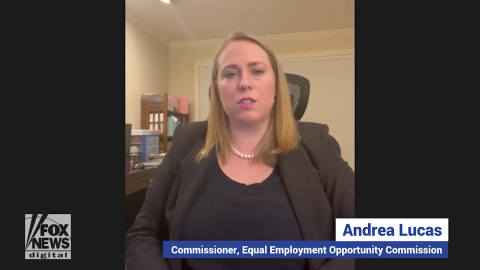
Finally, in the post yesterday 8/09/2025, we saw EEOC news: Lucas confirmed for second Commission term. From prior posts (including those on Mon. 2/24/2025, Fri. 2/28/2025, Tues. 3/11/2025, and Thurs. 4/17/2025) you know what that means.
Andrea Lucas says that she looks forward to working to further disavow DEI and that she remains “committed” to enacting the agenda set forth by the President.
Lucas, who is currently the Acting Chair for the EEOC, was confirmed by the Senat by a vote of 52 to 45. Her educational and legal background is detailed in the post.
Lucas did not look too far back in the statement she made after confirmation, only to the beginning of the current administration. At least part of that statement is in the post.
TAKEAWAY: Whether you like it or not, at least she does what she says she will and you know what you will get. Make sure your employment lawyer is on board.